

Case Study: Inside StaffDNA’s Approach to Voice AI Screening
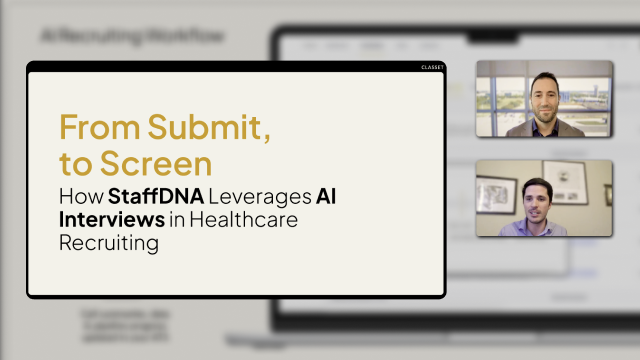
See how Classet's AI Interviewer works in the flow, and discover how StaffDNA is leveraging AI Interviews with guest speaker and StaffDNA CGO, Javier Llevada.
 Cooper Newby
November 5, 2025
case-studyExecutive Summary
In conversation with Chief Growth Officer of StaffDNA, Javier Llevada shared how Classet’s voice AI screening supports healthcare hiring by engaging healthcare professionals on their schedule, capturing richer context than CVs alone, and giving recruiters clear summaries for better follow-up conversations.
Inside StaffDNA’s Approach to Voice AI Screening
Healthcare recruiting is unique in that roles are specialized, the stakes are high, and the people you are trying to reach, nurses, allied health professionals, and other healthcare professionals, work schedules that do not map neatly onto recruiter calendars.
In a recent conversation with Javier Llevada, Chief Growth Officer at StaffDNA, we dug into healthcare hiring and how voice AI screening is improving the experience for candidates and recruiters.
The Timing Challenge in Healthcare Hiring
Healthcare professionals are often not sitting at desks refreshing email. They are on their feet, on night shifts, commuting between facilities, or grabbing windows of downtime wherever they can.
Javier put it simply: the part that excited him most about AI in screening was timing.
“I think the thing that excited me the most was the ability to provide information to candidates in a way that was easy for them to take in or to work through that fit their work-life balance, because I think in healthcare, you never know when healthcare professionals are available.
But I think that AI provides an opportunity to give our healthcare professionals information at times that suit them, and I think that really falls into what StaffDNA tries to do, which is to provide as much information as possible and be as transparent as possible with healthcare candidates at the time that best suits them.”
This is a core mismatch voice AI addresses: recruiting workflows are synchronous, but healthcare professional schedules are not. When screening requires a live call at a specific time, you lose candidates who want to talk but just cannot make it happen in a narrow window.
Voice AI screening flips that. It lets healthcare professionals engage when they have space without sacrificing the depth of a real conversation.
“You can either wake up early, or work really late. Or the third option is to have a voice AI screening tool so that you can get the information that they have maybe between the hospital itself and getting home on the drive. They can make a phone call.
I also believe that talking through my experience is usually a lot easier than to try to answer a bunch of questions that a recruiter's gonna throw at me. So I'd rather talk through my experience and then let the recruiter ask questions on top of that afterwards to fill in the gaps of what I missed.”
What stands out here is that the benefit is not only convenience. It is comfort. Healthcare professionals often prefer talking through their experience to filling out rigid forms or being peppered with questions on a rushed call. Voice AI gives them that conversational lane, but on their time.
Better Recruiter Conversations Start with Smarter Summaries
Once screening becomes more flexible for candidates, the next question is what happens on the recruiter side. If voice AI collects a conversation on the candidate’s schedule, how does that translate into better recruiting?
Javier’s answer was direct: the best AI screening does not replace recruiters, it helps them show up better.
“Well, I think the best thing that the AI screening can do for a recruiter is to summarize a lot of the conversation that they're having. Whether it's a transcription, AI that they're using, or the voice AI screening tools that Classet provides, I believe that allows the recruiter to have better conversations.
And to target different pieces of the experience, the candidate's experience… better with a voice AI screen that they've done.”
In practice, summaries shift recruiter calls from discovery to depth. Instead of spending the first 10 to 15 minutes reconfirming basics, recruiters can jump straight into what matters: motivations, constraints, and fit.
It is a subtle change with big compounding effects, especially in high-volume environments. Every minute you save on redundant screening is a minute you can invest in relationship-building and closing.
Cutting Through the Noise Leads to Better Matches
The challenge with early-stage recruiting is noise: too many profiles, too many generic applications, too much guesswork about what someone is really looking for.
Javier described the recruiter goal as cutting straight through that fog.
“I think being able to cut through the noise is something that every recruiter wants to do. I mean, as an organization, StaffDNA is always striving to cut through a lot of the extra information and get really down to what is it that a healthcare professional is looking for, when they're looking for their job.
Everybody's different, so knowing a summary of what they're looking for, especially through a conversation that they may have had with the voice AI, or with the recruiter directly, just makes things work more efficiently and then you're not wasting the healthcare professional's time.”
This is where voice AI materially changes outcomes. It turns vague early profiles into structured, human context:
What kind of unit or setting do they actually want?
What schedule constraints matter most?
What is motivating the move right now?
What would make them say yes to a role?
When you capture that early, match quality goes up and drop-off goes down, because you are not sending healthcare professionals into roles that do not fit their lives.
Why CVs are Not Enough in Healthcare Hiring
Resumes often don’t capture a candidate's nuances.
The formatting varies wildly. Two healthcare professionals with the same experience can look completely different on paper. And nuance, arguably the most important thing in clinical hiring, gets flattened.
“Well, I think that CVs in general are very widely varied. When you're looking at a CV, it's not always apparent how experienced someone is. Of course, you can see years, but you may not be able to see small nuances within the CV within that experience that a conversation can highlight very easily.”
A guided voice conversation fills those gaps quickly. It surfaces the small nuances that a CV misses:
micro-specialties inside a broader role
patient population experience
real-world scope of responsibility
confidence and clarity in how someone tells their story
Those details often determine whether someone thrives in a role or churns out in three months.
The Right Way to Adopt Voice AI: Start with Your Pain Points
AI is powerful, but only when applied with intention. The teams seeing the most value are not the ones grabbing shiny tools. They are the ones asking a practical question first:
What are our biggest pain points?
“When you're talking about where do you start… with your quest or your adventure into AI, and especially voice AI, it's where are the pain points that you think you need more efficiency? I think AI provides an unparalleled amount of efficiency if you use it correctly.
And you have to know your own organization and your own operations.”
In other words, voice AI is an efficiency multiplier, not a magic wand. If your bottleneck is recruiter time spent on first screens, it can unblock that. If your bottleneck is candidate drop-off because schedules do not align, it can solve that too.
But the path to impact starts with knowing your workflow, naming the friction, and implementing voice AI where it actually removes drag.
The Shift Happening Right Now
Put all these pieces together and the impact is straightforward: voice AI screening helps healthcare teams hire faster and better by improving the earliest touchpoints in the process.
It does that in a few connected ways:
It meets healthcare professionals where they are. When candidates can share their story at a time that fits their schedule, you preserve momentum instead of losing it to calendar mismatch.
It gives recruiters cleaner signal upfront. AI summaries turn first screens into useful context, so recruiters can walk into follow-up conversations prepared and focused on fit.
It surfaces nuance that resumes miss. Especially in healthcare, the details that matter most rarely show up cleanly on a CV. Conversation brings them out early.
It scales efficiency without sacrificing humanity. When implemented around real pain points, voice AI frees recruiters to spend more time doing the part of hiring AI cannot: building trust, advising candidates, and closing great matches.
In short, voice AI helps clear the bottlenecks that slow teams down, respects how healthcare professionals live and work, and helps recruiters spend less time digging for basics and more time having the conversations that actually move a hire forward.
Watch the Full Webinar:
Curious to learn about how ToF Automation and your customized screening agent can benefit your hiring team? Book a personalized demo with our Head of Partnerships, Johnny Rooney, Here.